The Restless Room
In a sleepy seaside town there is a hotel where one of the rooms is never occupied


On a hill overlooking the sleepy seaside town of Llandudno sits Marl Hall. It has been abandoned for years, but back in the 1800s it was a thriving hotel. It was close by Llandudno Junction, a station where many people would arrive and wait for their connecting trains to take them to their final destinations. Because it was the 1800s, such waits could be long, sometimes even overnight, and many chose to spend that time at Marl Hall. Many did, but no matter how busy it became, there was always one room that remained vacant.
Not because the owners did not want to rent it out, but because they couldn’t. not after what had happened to the last occupant who stayed there.
For years, guests who rented the room, regardless of how long they had intended to stay, would leave the very next day, usually in a hurry. The owners were kind people, and none of the visitors could bring themselves to complain about the room, so they made excuses for their sudden departures. It took years before the proprietors learned what happened there after dark.
Captain Ponsonby checked into the hotel during the day, and after spending a hot and sultry afternoon by the seaside, he retired to his room. He sat by the window, watching day turn into night. It was one of those perfect evenings when the moon was so bright that it illuminated the entire world.
When the Captain turned his gaze from the moonlit sea outside his window to his bed, he noticed something unusual. There was a depression in the bed, as if someone had been lying on it after it had been made. He wondered if the maid had taken a nap after finishing her work. Mildly annoyed, he considered raising a complaint with the manager but decided to wait until morning. If he still felt aggrieved, he would mention it then.
Captain Ponsonby undressed in his usual leisurely and methodical way and went to bed, soon falling asleep. He had no idea how long he had been asleep when he suddenly awoke with the distinct awareness that he was no longer alone in the room. Reaching out to switch on the light, his hand touched what felt like a head of dripping wet hair.
With a startled scream, he leapt from the bed and rushed to turn on the light by the door. To his relief, the room was empty. He searched thoroughly, looking everywhere, but found nothing that could explain what he had touched. He turned off the light and returned to bed, but sleep had deserted him. After lying awake for some time, he switched on the bedside lamp and read until morning.
At breakfast, he considered sharing his experience with a fellow guest or the proprietor, but he could already imagine their reactions: they would blame his imagination, a dream, or the beginnings of a nightmare. In the end, he said nothing, though he was convinced that something not of this world had entered his room. He decided to discover the truth behind the experience.
That night, soon after retiring but before falling asleep, he heard strange sounds outside his bedroom door, slow, shuffling footsteps, as though some large and clumsy person was moving about barefoot. Hardly daring to breathe, and carefully avoiding the furniture, the Captain crept silently to the door. He checked that it was locked, then placed his ear to the keyhole.
He strained to hear more, but all was now silent. Still, he was certain something was there, and a chill of fear crept over him. Quietly, he returned to his bed, switched on the bedside lamp, and turned to face the door for once again he thought he heard movement.
What he saw was the most terrifying sight of his life.
There, on the wall beyond the door, was the shadow of a figure, yet unlike any human form he had ever seen or imagined. It was misshapen, grotesque, seemingly naked, hunched, and covered in hair. Its long arms stretched out before it as it slid, or slithered, from one side of the room to the other. Yet there was nothing solid present to cast such a shadow.
Frozen with terror, the Captain watched as the noiseless form moved along the wall toward the bed. Then suddenly, it vanished, but at the same moment, the bed springs creaked, and a depression formed in the covers, as though something heavy had settled there. It was the same kind of impression he had seen the previous evening.
Deciding that discretion was the better part of valour, Captain Ponsonby resolved not to share his bed with an invisible presence. He dressed hurriedly, left the hotel, and spent the rest of the night walking along the seafront. Only when daylight came did he dare return to his room to rest.
When he awoke, it was mid-afternoon. He washed, ate an early meal, and determined to stay awake through the night, as he was no longer tired, he found a book he had long intended to read and settled himself comfortably, facing the bedroom door with the lamp behind him.
He endured several hours of darkness, but the room grew steadily colder, not just the temperature, the mood of the room as well. By midnight, he was overcome by a sudden and overwhelming terror, and once again he fled to the safety of the streets.
He walked and walked, eventually leaving the town behind. At last, he came to a crossroads and sat down to rest. Though dawn seemed near, the sky remained a dark velvet, filled with stars. Then he heard it, a familiar sound behind him: slow, shuffling footsteps, like those he had heard outside his door.
As the sound drew nearer, he stood and turned toward it, but saw nothing. He began to run back toward Llandudno. Behind him, the footsteps followed. Several times he stopped, and each time he thought he heard them, faint but unmistakable. Still following.
Yet by the time he reached the town, the sound had ceased.
Back at the hotel, exhausted, the Captain threw himself onto the bed and slept undisturbed until morning. Later that day, out out options, he finally resolved to directly ask the proprietor if he could shed any light on the strange occurrences.
Taking him aside, the quiet little man told a story that explained one of the strangest hauntings imaginable.
In their youth, he and his wife had had a son, born with a misshapen body and a mind that never developed beyond infancy. Despite his appearance, the boy had been gentle and affectionate, but ashamed of how guests might react, his parents kept him hidden from view.
When the boy was nineteen, a niece came to visit with her fiancé. One moonlit night, the couple went for a walk to the very crossroads where Captain Ponsonby had rested. Unbeknownst to them, the son had been watching and followed them into the night.
He meant no harm, he had simply been captivated by the young woman’s beauty. But when he suddenly emerged from the darkness, they were terrified and fled back to the hotel.
The boy was never seen alive again.
Two days later, his battered body was found among rocks at the base of nearby cliffs.
It was after this tragedy that strange occurrences began in the boy’s former room.
For a time, the room was never let. But as years passed, it was occasionally used again. When no complaints were made, it gradually returned to regular use—until Captain Ponsonby’s experience.
After hearing his account, the proprietors locked the room and never rented it again.
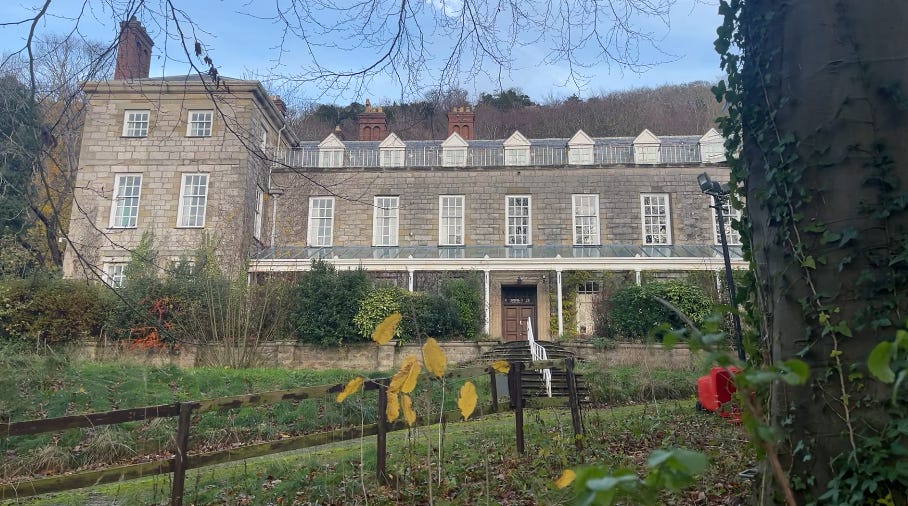
When this story was published, Marl Hall had burned down some years ago, and it was the belief that the destruction of the hotel had severed the boys connection to the place. But in the 150 years since, Marl Hall has been rebuilt, and it seems like it has never found rest itself. It has served many purposes but usually not for long. Every time it has opened up under a new banner, it has closed its doors after only a few years. Most recently it was an outdoor educational center, but it only served that purpose for 6 years, and has stood empty since 2011